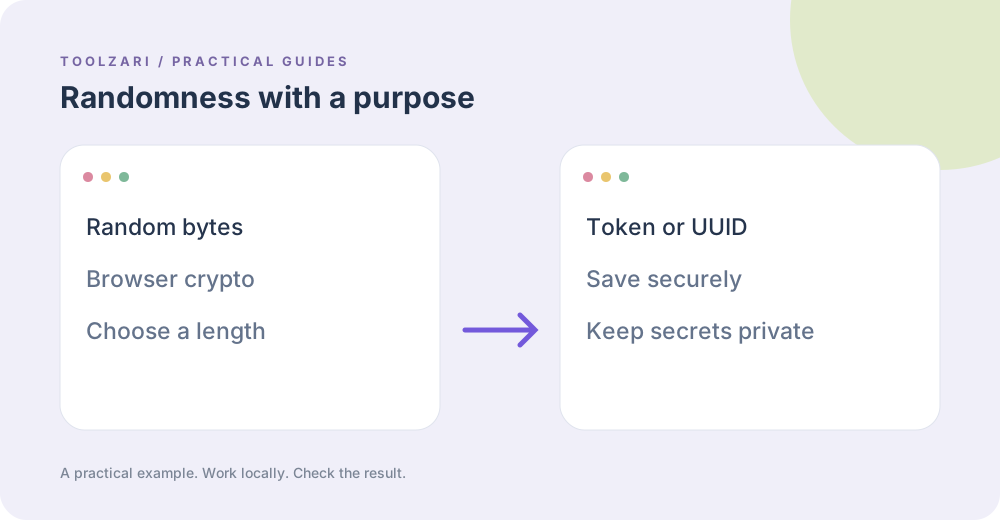
Tokens versus IDs
A secure token is intended to be hard to guess. A UUID identifies an item with very low collision risk, but it should not be treated as a password or authorization secret. Use Secure Token Generator for secrets and UUID Batch Generator for public record identifiers.
Choose a token length
Enter a byte count from 1 to 1024. The generator calls the browser’s cryptographic random source and prints hexadecimal text, two characters per byte. For an ordinary application secret, 32 random bytes provide 256 bits of raw entropy. Store it securely; the tool does not save it or email it.
Make IDs in a batch
Enter a count from 1 to 1000 in UUID Batch Generator. Each output is a new UUID v4. Check the destination system’s preferred format and uniqueness constraints before importing a batch.
Handle secrets responsibly
Avoid pasting tokens into public issue reports, URLs, screenshots or analytics fields. A locally generated token still needs safe storage, access controls and rotation if exposed.
A small worked example
Entering 32 in Secure Token Generator yields 64 hexadecimal characters, because each byte becomes two hex digits. Running it twice should produce unrelated values. Entering 5 in UUID Batch Generator yields five separate version 4 identifiers. Use the token as a private secret, and use UUIDs only as IDs; neither tool provisions an account or stores its output.
Tools used in this guide
- Secure Token Generator — Generate cryptographically random hexadecimal tokens.
- UUID Batch Generator — Create up to 1000 UUID v4 identifiers locally.
- Password Generator — Generate strong random passwords with configurable length and character sets.