An ID has a different job from a secret
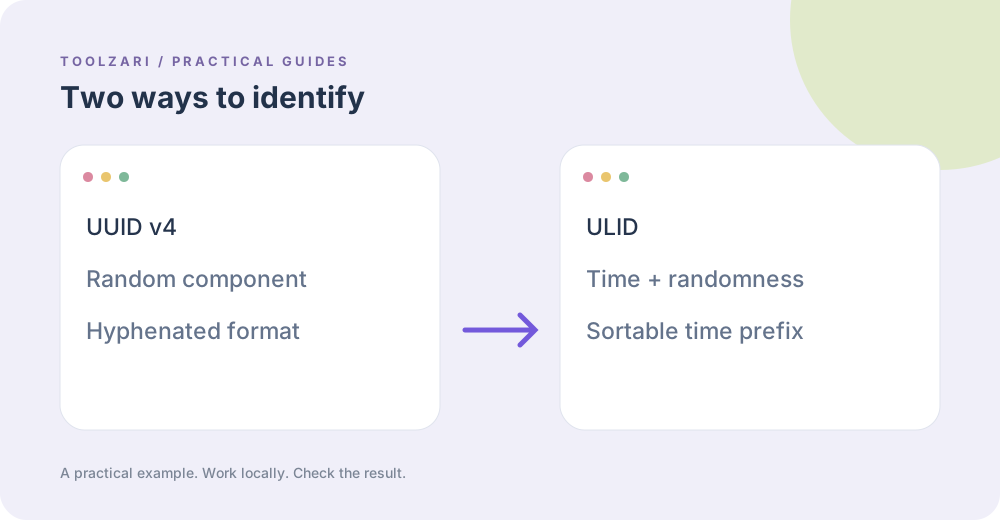
An identifier labels a record; a token authorizes access or proves possession. UUID Generator and UUID Batch Generator create version 4 UUIDs with a random component. ULID Generator creates a compact time-prefixed string. Neither type should replace authorization checks or password storage.
Try both formats
Generate a UUID and note its hyphenated form. Generate several ULIDs a moment apart and observe their common leading time portion and later differences. A ULID can be convenient when sorting roughly by creation time, but local clocks can drift and random ordering within the same millisecond is implementation-dependent.
Plan for storage and imports
Check what your database, API and external partners accept. A UUID column may reject a ULID string; case normalization and length limits also differ. If you bulk-create IDs, verify uniqueness constraints on the destination system and store them consistently.
Do not expose data through assumptions
A time-prefixed identifier can reveal approximate creation time. A random-looking ID is not an access control policy. If you need a secret link or API credential, use Secure Token Generator and back it with expiration, permissions and server-side checks.
Test real integration
Make a staging record with each candidate, fetch it through the intended API, and check sorting, validation and backups. Choosing an ID format is a data-model decision, so write down the tradeoffs before migrating an established table.
Tools used in this guide
- UUID Generator — Generate random UUID v4 values in bulk with quick copy actions.
- UUID Batch Generator — Create up to 1000 UUID v4 identifiers locally.
- ULID Generator — Generate Universally Unique Lexicographically Sortable Identifiers (ULIDs) for time-ordered unique IDs.
- Secure Token Generator — Generate cryptographically random hexadecimal tokens.